There’s a reason conscious connected breathing keeps coming up in conversations about stress relief, trauma recovery, and emotional healing. It’s not a trend. It’s not a rebranded meditation technique. And it is definitely not another thing where you sit quietly and try to think nicer thoughts.
This is something different. Something that works on the body directly, bypasses the overthinking mind entirely, and produces results that most people describe as immediately undeniable. I know, because it changed my life before I ever fully understood why.
What Conscious Connected Breathing Actually Is
The name tells you exactly what it does if you break it down. Every breath is conscious, meaning intentional and directed. And every breath is connected, meaning there is no pause between the inhale and the exhale. No stopping at the top. No holding at the bottom. Just a continuous, rhythmic flow of breath that loops without interruption.
You breathe in through the mouth into the belly, then into the chest, and exhale everything back out through the mouth. Then you do it again. And again. Without stopping. That’s the whole mechanic.
It sounds almost too simple. That’s part of why people underestimate it until they’re in it.
The technique is also known as circular breathing, which describes the same thing from a different angle. The breath cycles continuously like a circle, no beginning, no end, just a loop that keeps moving. This is the exact technique I teach in every class, because in over a decade of doing this work I have not found anything that delivers results this consistently and this fast.
Why the “Connected” Part Is the Most Important Piece
Most people go through life breathing on autopilot. Shallow chest breathing, barely filling the lungs, small inhales, incomplete exhales. You’re technically alive, but the body is running on a fraction of what it could be receiving.
When you add the connected element, removing those pauses between breaths, something shifts in the nervous system. The autonomic nervous system, which regulates your stress response, your heart rate, your digestion, and about a thousand other things you never consciously think about, starts to respond to the sustained rhythm of the breath.
The body begins to move out of the chronic low-level fight-or-flight state that most people don’t even realize they’re living in. That constant underlying tension starts to dissolve. And when that happens, things that have been held in the body, emotionally and physically, start to move.
That’s not poetic language. That’s what the body actually does when you give it permission to shift.
If you want to understand more about what breathwork does to the nervous system and why the results can show up so quickly, the post on breathwork benefits breaks it down in real detail.
What Happens When You Do It
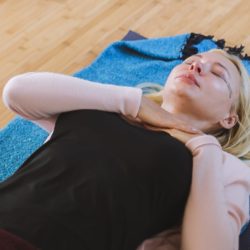
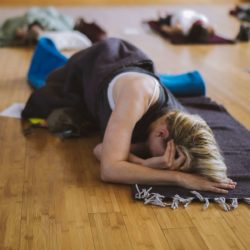
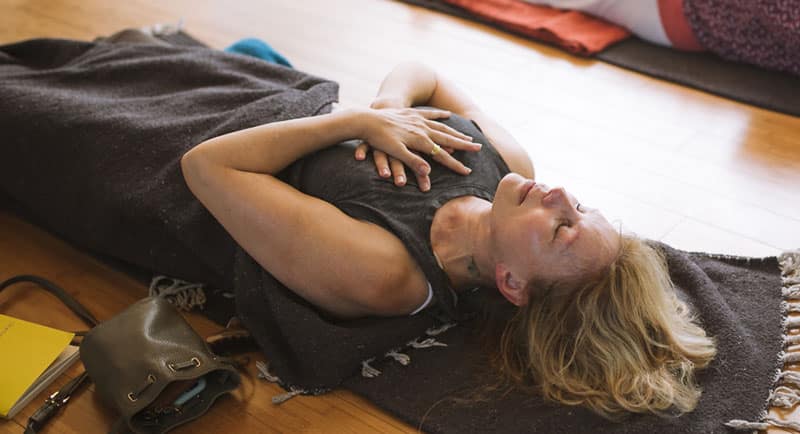
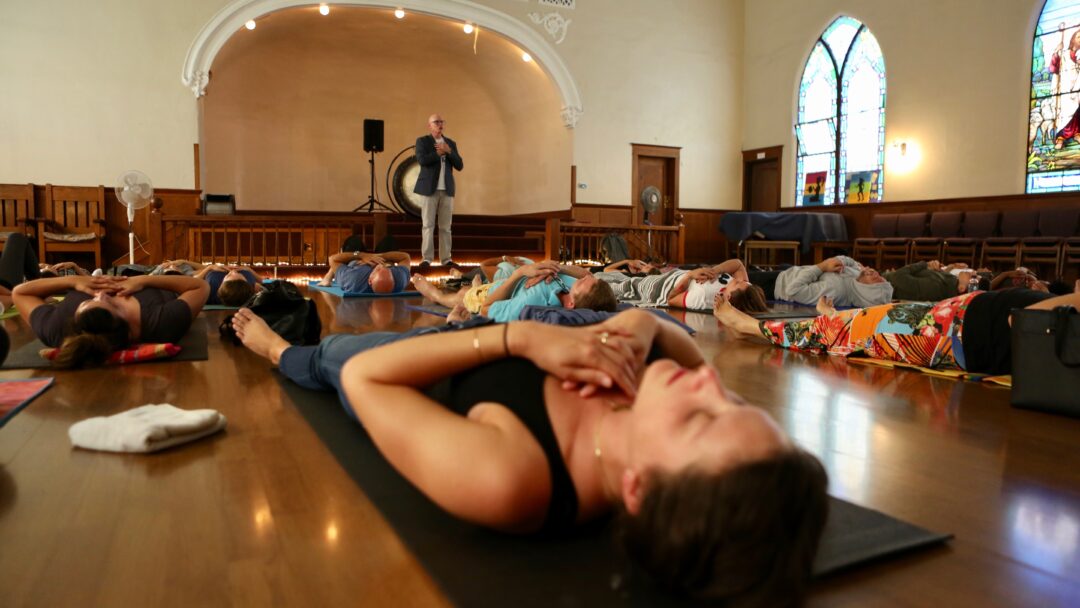
You lie down on your back. Blanket nearby. Eyes closed. Music on.
The first few minutes feel manageable. You’re breathing through the mouth, connecting each inhale to the exhale, and it feels like something you can handle fine.
Then around the 10 to 12 minute mark, the brain decides it has had enough.
“This is a waste of time.”
“My hands feel weird.”
“I should probably stop.”
That is the hump. Every person who has ever done conscious connected breathing has hit it. The mind throws everything at you to get you to quit right at the point where the practice is starting to actually work.
The brain’s job is not to make you happy. Its job is to keep you safe, and “safe” in the brain’s world means doing nothing new, nothing unfamiliar, nothing that creates physical sensation it hasn’t catalogued yet.
Push through that window and the brain backs off. The resistance drops, the breath becomes easier to sustain, and the session opens into something completely different. What happens next varies from person to person and session to session.
Some people feel waves of emotion. Some feel a warmth or vibration moving through the body. Some cry, some laugh, some feel a stillness unlike anything they have ever experienced.
What they almost all have in common is that they want to do it again.
This Is Not Meditation, and That Distinction Matters
One of the most common misconceptions about conscious connected breathing is that it’s a form of meditation. It’s not, and the difference is significant.
Meditation asks you to observe the mind, to sit with thoughts as they arise and resist reacting to them. That is a real and valuable skill. But for people carrying significant stress, anxiety, or stored emotional weight, that kind of practice can actually be frustrating, because the mind has a lot to say and sitting with it doesn’t always give those things somewhere to go.
Conscious connected breathing does not ask you to observe anything. It moves you past the thinking mind entirely through a physical process. You’re not trying to quiet your thoughts.
You’re breathing so continuously and completely that the part of the brain that generates constant mental chatter, the prefrontal cortex where the ego and inner critic live, temporarily steps back. The body leads. The mind follows.
One of my favorite things is when someone shows up to their first class completely skeptical. Arms folded. Reluctant expression. The whole thing. In my experience, those are often the people who have the most profound sessions, because they’ve been holding on the tightest and they need the release the most. The breath doesn’t care what you believe about it going in.
Don’t take my word for it. Try it once and find out for yourself.
If you’re wondering what sets this apart from the other breathwork approaches out there, this post on the types of breathwork is a useful read. It explains why I focus on this particular technique above all others I’ve trained in.
What It Can Help With
I have watched conscious connected breathing help people with things that surprised even me after all these years.
Stress and anxiety respond fast. The nervous system regulation happens during the session itself, not weeks later. People feel calmer, clearer, and more grounded by the time the active breathing ends, sometimes in a single session. For many, it is the first time they have felt genuinely calm in years, not medicated calm, not distracted calm, but actually settled.
Trauma is where things get deeper. Trauma doesn’t live in the mind the way people assume. It lives in the body, in the tension patterns, the shallow breathing, the places where the nervous system got stuck in protection mode and never fully came back out.
Conscious connected breathing gives the body a direct pathway to move that stored material. Not by talking about it, not by analyzing it, but by creating the physiological conditions in which the body can finally let it go.
Chronic pain, sleep problems, lack of focus, emotional numbness, the feeling that something important is buried under years of just keeping it together. These are all things I see shift through consistent practice.
I want to be clear about something. This is not a cure-all, and I’m not here to oversell it. But I’ve been doing this work for over a decade, teaching hundreds of people at a time, and the results are consistent enough that I built my entire teaching practice around this one technique.
Is Conscious Connected Breathing Safe?
For most healthy adults, yes. In over a decade of teaching, I have never seen anything harmful happen. Zero reported cases of anything serious from this type of breathwork. Zero.
That said, there are some contraindications worth knowing. Anyone with a history of cardiovascular disease, high blood pressure, glaucoma, seizure disorders, or current pregnancy should check with their doctor before starting. If you’re on major medications, same thing. Check first.
Some people experience tingling in the hands or face during the session, or their hands may tighten and curl, a phenomenon called tetany. It’s not dangerous. It’s a physiological response to the shift in CO2 levels in the blood, and it resolves as soon as you ease off the breath. I cover this before every session so nobody is caught off guard.
For a thorough look at safety, side effects, and what the research actually says, the post on breathwork safety answers all of it plainly.
How Often You Need to Do It
One session is enough to feel something real. Most people do.
But one session won’t transform your life the way consistent practice will. The deeper work, the kind that changes how you relate to stress, how you process emotion, how you sleep, how you show up for yourself and everyone around you, that comes from showing up regularly.
Once a week is a powerful starting point for most people. For those going through something heavy, more frequent sessions can accelerate the process significantly. And the single most useful thing you can add to a regular weekly session is a short daily practice, even just a few songs worth of breathing in the morning before the noise of the day begins.
If you want a detailed breakdown of how to structure a practice that actually creates lasting change, the post on how often to practice lays it out honestly and practically.
You Already Have Everything You Need
That’s the part that still gets me after all these years.
You don’t need a gym membership. You don’t need a prescription. You don’t need a therapist’s couch or a retreat in Bali or an expensive supplement. You just need your breath, a flat surface, and the willingness to stay in it when things get uncomfortable.
Conscious connected breathing is one of the most accessible and most powerful tools available, and most people have never tried it. Not because it’s hard to find. Because it sounds too simple to believe. The results have a way of fixing that.
Frequently Asked Questions (FAQs)
1. What Is Conscious Connected Breathing?
Conscious connected breathing, also called circular breathing, is a technique where you breathe in and out through the mouth continuously without pausing between the inhale and the exhale.
The uninterrupted rhythm activates the nervous system, bypasses the thinking mind, and creates the conditions for emotional and physical release. It is the core technique taught at Breathe with JP.
2. How Is It Different from Regular Deep Breathing?
Regular deep breathing usually involves slow, deliberate inhales and exhales with pauses in between. Conscious connected breathing removes those pauses entirely and sustains the breath continuously for the full session.
That connected rhythm is what creates the physiological shift in the nervous system and opens the door to the deeper emotional and physical benefits the practice is known for.
3. Will I Feel Uncomfortable During a Session?
Probably, especially the first time. Tingling, unexpected emotion, tightness in the hands or jaw, these are all normal and temporary. They’re signs that something is shifting, not that something is wrong. The most important thing is to stay with it through the uncomfortable part, because that’s exactly where the practice delivers its results.
4. Can I Practice Conscious Connected Breathing on My Own?
You can, but starting with a guide is strongly recommended, especially for the first several sessions.
Having a facilitator keeps you in the practice when resistance peaks, holds the space when emotion surfaces, and ensures you’re using the technique correctly. Once you’re familiar with the process, building a solo practice alongside group sessions becomes a natural next step.
5. How Long Before I See Real Results?
Most people feel a genuine shift after their very first session. The immediate effects, the sense of calm, the emotional release, the clarity, are real. Lasting change in how you handle stress, how you sleep, and how you relate to yourself comes with regular practice over time.
The first session shows you what’s possible. Consistent practice is what makes it permanent. Conscious connected breathing is the kind of tool that grows with you the longer you use it.