If you’ve been exploring breathwork meditation as a way to reduce stress and get more present, the first thing worth knowing is this, breathwork and mindfulness are not the same thing.
They work differently, they feel different, and they ask different things of you. Mixing them up is one of the main reasons people end up confused about why one seems to work and the other doesn’t.
That said, they complement each other in a way that very few practices do. And once you understand the difference, you can use specific breathwork techniques to make your mindfulness practice more accessible than it has ever been.
Why Breathwork and Mindfulness Are Different
Let’s be clear on this before anything else.
Mindfulness is the practice of present-moment awareness. You observe your thoughts, your sensations, your breath, without reacting to them. You’re not trying to change anything. You’re learning to sit with what’s there.
That’s a real skill and a valuable one. But for a lot of people, especially those carrying significant stress or anxiety, it’s also frustratingly difficult. If your mind is a blender running on high, sitting quietly and observing the noise is not always a realistic starting point.
Breathwork is something entirely different. It’s an active, physical practice. You use a deliberate breathing technique to shift your physiological state directly. You’re not observing, you’re doing. The body is engaged, the nervous system is responding, and things move through you rather than sitting in your head waiting to be observed.
I used to say breathwork was a form of meditation. I’ve since changed my mind on that.
What I will say is this. The state your body arrives at after a breathwork session is exactly the state that mindfulness practice is trying to help you reach. Clear head. Quiet mind. A body that finally feels settled. For a lot of people that’s the closest thing to genuine presence they’ve ever experienced, and they got there through a completely different door.
So the question isn’t which one to choose. It’s how to use breathwork to create the internal conditions where mindfulness becomes natural instead of forced. That’s the real opportunity here. And this post on is breathwork meditation goes deeper on exactly where that line sits.
What Breathwork Does That Mindfulness Can’t Do on Its Own
Here’s what most people don’t realize about circular connected breathing, which is the technique I teach. When you breathe continuously through the mouth without pausing, something very specific happens in the prefrontal cortex, the part of the brain where your inner critic, your constant self-commentary, and your ego all live.
It temporarily quiets down.
The term for this is transient hypofrontality. In plain language, it means the part of your brain that has been running commentary all day, judging everything, worrying about the future, replaying the past, gets a break. Not because you forced it quiet. Because the breath did it mechanically.
That is what my students mean when they tell me a session felt like “20 years of therapy without having to say a word.” You’re not thinking your way through anything. The breath moves you past the thinking mind, and the quiet on the other side is the kind that most people have been trying to find in meditation for years without being able to access it.
Breathwork doesn’t replace mindfulness. It clears the road so mindfulness has somewhere to land. And it gives you a reference point of where you wanna try and get to when you’re doing mindfulness.
And if you’re consistently using breathwork to move through the week’s accumulated stress and anxiety, your baseline level of mental noise comes down over time. The mindfulness practice that felt like fighting your own brain starts to feel like something you can actually do.
The Breathwork Techniques Worth Knowing
These are the specific techniques that reduce stress most effectively and set you up for a real mindfulness practice afterward.
Circular Connected Breathing
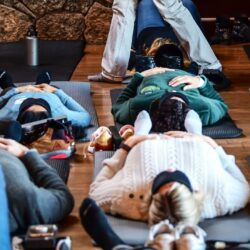
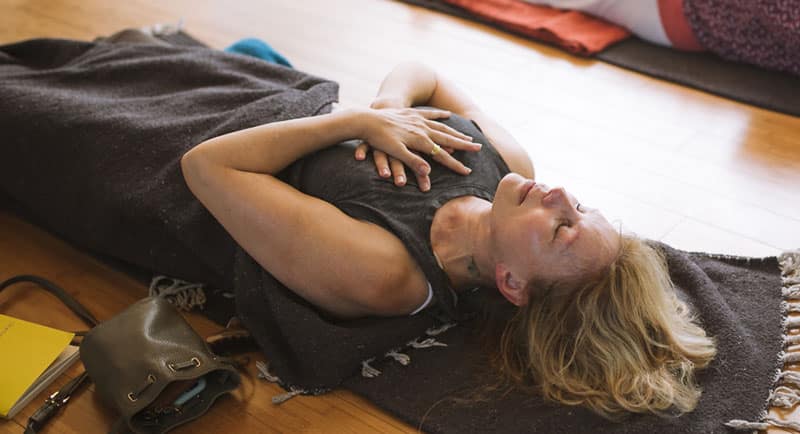
This is the main technique I teach at Breathe with JP, and the most powerful one on this list. You lie flat on your back and breathe in through the mouth into the belly first, then into the chest. Exhale everything back out through the mouth immediately, with no pause at the top or the bottom. Continuous. Circular. No gaps.
A full session runs about 28 minutes of active breathing followed by a rest period. During the active phase, your nervous system shifts. Cortisol drops. Muscle tension held in the jaw, chest, and shoulders releases. Stored emotional material starts moving. After the active breathing ends you lie still and let your body integrate.
That rest period is not optional, and it is specifically where the mindfulness shows up naturally. Your mind is quiet in a way it probably isn’t at any other point in your day. You don’t have to chase presence. It’s just there.
Coherent Breathing
This one is quieter and more accessible as a daily practice. You breathe in through the nose for six seconds, and out through the nose for six seconds, with no pause at the top or the bottom. Just like circular breathing, it’s connected. The difference is the pace, the nose, and the intensity.
Where circular connected breathing is a full workout, coherent breathing is a tool you can use anywhere, including at your desk, before a difficult conversation, or when something stressful happens and you need to shift your state quickly without lying down.
The six-second rhythm has been studied specifically for its effect on heart rate variability and nervous system regulation. It’s one of the most effective techniques I know for bringing the body out of a stress response in real time.
Breath Observation as a Mindfulness Bridge
After a circular connected breathing session, your mind is in a receptive state. This is the ideal moment to practice simple breath observation. You’re not directing the breath or changing anything. You’re just noticing it. In. Out. The sensation at the nostrils or the rise and fall of the chest.
This is technically mindfulness, not breathwork. But doing it in the immediate aftermath of a session is dramatically more effective than trying to start cold. The breathwork has already quieted the mental noise. The observation practice can actually take hold in a way that it often can’t when you sit down to meditate without that preparation.
That layered approach is something worth experimenting with.
How Breathwork Builds Mindfulness Over Time
The benefits of breathwork accumulate in a way that directly supports a mindfulness practice. This is the compounding effect that regular practitioners notice most clearly.
When you use breathwork consistently, you’re clearing the emotional and physiological backlog that keeps showing up every time you try to sit and be present. The grief that has nowhere to go.
The resentment that’s been sitting in the chest for years. The underlying anxiety that surfaces the moment things get quiet. Breathwork gives all of that somewhere to move. And when those things have moved, the quiet that’s left behind is a different quality of quiet.
Mindfulness practiced from that baseline lands completely differently. You stop fighting your own mind. The presence you’ve been working toward starts showing up in ordinary moments outside of formal practice. You notice a longer gap between what happens and how you respond. That’s not a small thing. That’s the whole point of mindfulness practice.
And it gets there faster when breathwork is doing the clearing underneath it. For a realistic look at how often you need to practice for that to happen, that post gives you an honest breakdown.
What Most People Get Wrong About This
A lot of people treat breathwork and mindfulness as interchangeable, pick whichever one feels easier that week, and then wonder why neither one is producing lasting change.
They work together, not instead of each other.
Breathwork is the active part. It releases what’s stored, shifts the nervous system, and does the physiological work that meditation can’t do on its own. Mindfulness is the receptive part. It builds the awareness and presence that helps you live differently between sessions.
If you only do breathwork you’ll feel good after sessions but won’t necessarily be building the sustained awareness that mindfulness develops. If you only do mindfulness without addressing the backlog of stress and emotion underneath it, sitting practice will feel like a battle more often than not.
Use them together, in that order. Breathwork first. Mindfulness after. Both reduce stress, but they do it differently, and the combination is more than the sum of its parts.
Frequently Asked Questions (FAQs)
1. Is Breathwork the Same as Mindfulness Meditation?
No. They are genuinely different practices. Mindfulness asks you to sit and observe thoughts and sensations without reacting. Breathwork is an active physical technique that uses deliberate breathing patterns to shift the nervous system and release stored emotional and physiological tension.
The important connection between them is that breathwork creates the internal conditions that make mindfulness significantly more accessible. Think of breathwork as the clearing, and mindfulness as the building.
2. Which Breathwork Technique Is Best for Reducing Stress?
Circular connected breathing produces the most immediate and complete stress relief of any technique I’ve worked with in over 15 years of teaching. Coherent breathing at six seconds in and six seconds out is the most practical tool for quick real-time stress relief throughout the day. Both have their place, and they work well used together as a regular practice.
3. Can I Do Breathwork and Mindfulness in the Same Session?
Yes, and this combination works particularly well. Do the active breathing technique first for a full session, then use the rest period that follows for breath observation or simple mindfulness practice. Your mind will be in a much quieter and more receptive state than it typically is when you sit down to meditate cold, and the mindfulness will land more deeply as a result.
4. How Often Do I Need to Do Breathwork for It to Improve My Mindfulness?
Once a week is a solid starting point and produces noticeable changes over time. Daily practice, even a shorter session of 10 to 15 minutes in the morning, accelerates the process significantly. The consistency is more important than the length of any individual session. Show up regularly and the baseline shifts. That’s when the mindfulness practice starts changing too.
5. Is Breathwork Safe for People with Anxiety?
For most people, yes. In fact, stress and anxiety are the most common reasons people try breathwork in the first place, and the results are consistently strong. The active breathing phase can feel intense initially, particularly if anxiety is already high, but the technique works by shifting the nervous system out of the exact state that anxiety lives in.
Anyone with a diagnosed anxiety disorder or other medical condition should check with their doctor before starting, but the practice itself is not contraindicated for anxiety in general.