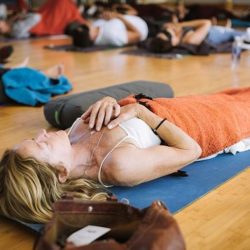
Most people come to online breathwork expecting a compromise. The real thing, they assume, happens in a studio. Online is fine if you can’t make it in person, but it’s a trade-off for convenience. What they discover, usually in the first session, is that this assumption was wrong.
The format isn’t a limitation. For a significant number of people, it’s actually what makes the practice work as well as it does. This article explains why, and what online breathwork specifically offers that traditional in-person formats often can’t.
The Assumption Worth Questioning
There’s a belief embedded in a lot of wellness culture that in-person is inherently better. That the shared physical space, the group energy, the studio environment adds something essential that a screen can’t replicate. For some modalities, that’s probably true. For breathwork, the evidence of experience tells a more complicated story.
The reason is simple. Breathwork works by creating safety. Safety in the nervous system is the threshold the body needs to cross before it will release anything it has been holding. A beautiful studio helps with that. So does a skilled facilitator. But the most potent safety signal most people’s nervous systems will ever receive is being in their own home.
Their own temperature. Their own sounds. Their own space. That specific safety is something a studio environment, no matter how well-designed, cannot fully replicate.
And when the nervous system feels safe, the work goes deeper.
What Flexibility Actually Means Here
When people hear “flexibility” in the context of online breathwork, they usually think of scheduling. And yes, being able to join a live class from home without commuting matters. It’s a real reduction in friction and friction is one of the main reasons people abandon practices they genuinely want to maintain.
But the flexibility that matters more is psychological.
In a studio, there are other people present. Some part of your awareness is always on them, even if it’s minimal. You’re making micro-decisions about how you’re taking up space, whether the sounds you’re making are appropriate, how you’re presenting yourself during and after the session.
That self-monitoring happens without permission. It’s not a character flaw. It’s just how people work in shared physical environments.
At home, that monitoring disappears. You can cry as loudly as you need to. You can move. You can laugh at something unexpected without worrying what it looks like. You can stay on your mat for as long as you want afterward without the subtle pressure of a room full of people returning to normal life around you.
That freedom changes what you’re able to access in the session. The emotional range available to you expands when no one is watching. And in breathwork, that range is the whole point.
Understanding the full scope of what breathwork can address, from daily stress to deep emotional patterns, starts with understanding the types of breathwork and which ones produce that kind of depth.
What Mindfulness Actually Has to Do With It
The word mindfulness gets used so broadly in wellness culture that it’s nearly lost its meaning. But in the context of online breathwork, the connection is specific and worth explaining clearly.
Mindfulness in its simplest definition is the capacity to be present with your own experience without being swept away by it. To notice what’s happening in your body and mind without immediately reacting to it, interpreting it, or trying to change it. That capacity is genuinely useful.
The problem is that most people can’t actually access it. Not because they’re doing mindfulness wrong, but because the nervous system they’re trying to practice in is too activated for stillness to land. The mind is loud. The body is tense. The quiet they’re trying to create keeps filling back up with noise.
Online breathwork addresses this from the bottom up.
Circular connected breathing, the technique at the core of a real breathwork session, produces a state in the brain that most quiet sitting practices spend months trying to approach. The prefrontal cortex, the part of the brain responsible for inner commentary, self-criticism, planning, and replaying past events, downregulates during active circular breathing.
This state is called transient hypofrontality. The analytical mind doesn’t go away, but it quiets. What’s left is presence. Direct experience without the layer of narration sitting on top of it.
That’s the state mindfulness is trying to cultivate. Online breathwork doesn’t cultivate it gradually through repeated effort. It creates it, reliably, in about 28 minutes. And the clarity that follows a session makes every other practice, including quieter forms of meditation and mindfulness, dramatically more accessible.
The mind has less to grip onto. The body has released some of what it was holding. The practice lands differently. The relationship between these two approaches and how they intersect is worth understanding if you’re serious about either one, what most people discover is that breathwork and stress and anxiety relief aren’t separate conversations.
Breathwork addresses the physiological layer that no amount of thinking about stress actually touches.
What the Body Does During an Online Session
A common question from people new to online breathwork is whether they need a facilitator physically present in case something intense happens. It’s a reasonable question and it deserves a straight answer.
The physical sensations that come up in circular connected breathing are well-documented and almost universally safe for healthy people. Tingling in the hands and face. Warmth moving through the body. Lightheadedness. A feeling of emotional fullness that sometimes tips into unexpected release.
These are not medical emergencies. They are physiological responses to changes in carbon dioxide levels during active breathing, and they resolve on their own when the breathing normalizes.
Understanding exactly why your hands curl during a session, and what it actually means for your body, removes the fear that stops people from staying in the practice when it counts.
A well-run online breathwork session includes a full explanation of all these responses before the active breathing begins. You won’t encounter anything in a live session that wasn’t explained to you in advance.
And a trained facilitator is present throughout, not across a room, but through your headphones, cuing your breath, checking in, and holding the space with you. The medium changes. The presence doesn’t.
The Consistency Argument
One session of online breathwork will give you a result you can feel. There’s almost no one who does a real session for the first time and doesn’t notice something significant afterward. Better sleep that night. A sense of space in the chest. Less reactivity the next day. Something shifted, even if it’s hard to name precisely.
But a consistent practice changes the baseline. And this is where online breathwork has a structural advantage over in-person formats that most people don’t appreciate until they’ve lived it.
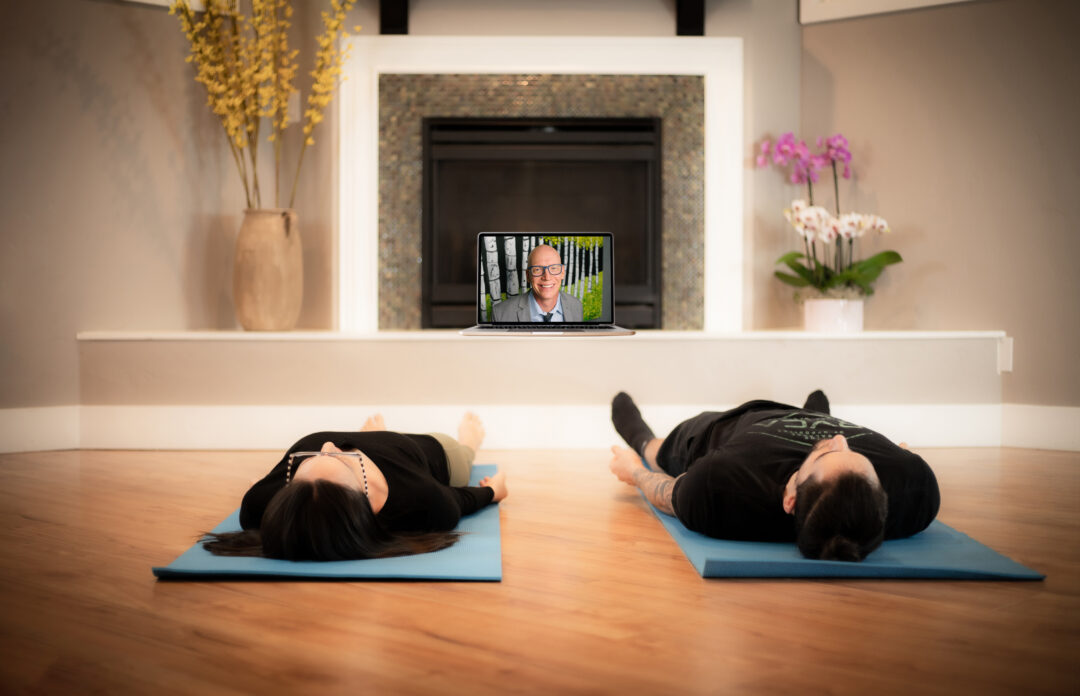
When breathwork lives on your phone or laptop, it belongs to your life in a way that studio classes don’t. You roll out a mat in your living room at the same time each week. The ritual is yours. The space is yours.
There’s no parking, no commute, no getting dressed for it. The lower the barrier, the higher the likelihood you actually show up. And with this practice, showing up is everything.
The results that make people lifelong practitioners, the ones who describe it as the most important thing they do for their mental and emotional health, come from repetition. They come from coming back after a session that felt flat. From coming back when life gets busy. From treating it as something that belongs to the week the way sleep belongs to the night.
Online breathwork makes that level of consistency achievable for ordinary people with full schedules. Not because it’s easier in any demanding sense. Because the friction has been removed, and what remains is the work itself.
The Range of People It Reaches
Part of what makes online breathwork worth paying attention to is who it’s actually reaching.
People in recovery have found it one of the most effective tools available for moving through the emotional weight underneath addiction and alcoholism without replicating the conditions that made substances appealing in the first place.
People working through grief, burnout, and the diffuse, hard-to-name emotional heaviness that accumulates from years of pushing through rather than processing, all of them show up in online breathwork sessions. The practice doesn’t require that you name what you’re carrying. It works on the body level, which is where that weight actually lives.
The online format specifically expands the reach further. People who live in areas with no local breathwork teachers. People whose schedules make Tuesday night studio classes impossible. People with physical limitations that make travel difficult. Online breathwork is not a compromise solution for those people. It’s the access point that wouldn’t exist otherwise.
That’s something worth sitting with. One of the most powerful somatic practices available, delivered through a laptop or phone, to anyone with a mat, a pair of headphones, and a quiet hour. Online breathwork started as a convenience. It turned out to be something larger than that.
Frequently Asked Questions (FAQs)
1. Is Online Breathwork as Effective as In-Person Breathwork?
Yes. The research on physiological and emotional outcomes doesn’t distinguish meaningfully between online and in-person formats when the technique and facilitation quality are equivalent.
Many people report that their most significant sessions happen at home precisely because the familiar environment allows deeper nervous system relaxation, which is the threshold the body needs to cross before real release becomes available.
2. What Do I Need to Start Online Breathwork?
A flat surface to lie on, a blanket. A reliable internet connection for live sessions. A space where you can be uninterrupted for the duration of the session. That’s the full list.
You don’t need special equipment, prior breathing experience, or any particular level of physical fitness. What you need is the willingness to show up fully and stay with the practice when it asks something of you.
3. Can Online Breathwork Help with Mindfulness Practice?
Directly. Breathwork produces neurological conditions that make mindfulness significantly more accessible. After a session, the mental noise that makes quiet sitting difficult has been reduced at the physiological level, not just managed at the surface.
People who struggle to meditate consistently often find that online breathwork creates the internal environment that makes their other practices finally land the way they were supposed to.
4. What Should I Expect to Feel During an Online Breathwork Session?
Tingling in the hands and face, warmth or energy moving through the limbs, unexpected emotion, and a quality of mental quiet that most people haven’t experienced while fully conscious. Some people cry. Some laugh. Most notice a significant difference in how they feel afterward, even if the session itself was uncomfortable at moments.
The discomfort, particularly around the 10 to 12 minute mark, is normal and worth staying through. Everything meaningful tends to happen on the other side of that resistance.
5. How Often Should I Practice Online Breathwork for Real Results?
Once a week produces real, compounding change. More frequent shorter practice accelerates those results, particularly if you’re working through something significant emotionally or physically. The most important factor is consistency over time, not intensity in any given session.
The people who experience the most lasting change are the ones who come back regularly, not necessarily the ones who push hardest in a single session. Starting with one weekly session and building from there is a strong approach for most people.